BS EN 81-72: Safety rules for the construction & installation of lifts – Fire fighting lifts
DESCRIPTION
Exclusive use of a passenger lift by the fire service to carry firefighters and their equipment to the required floors in the event of a fire.
Firefighters lifts are required in tall buildings greater than 18m and buildings with deep basements greater than 10m. Further detail can be referenced in BS 9999 cl. 20.4
FEATURES
Primary and secondary power supply (by others) to enable the lift to remain in use
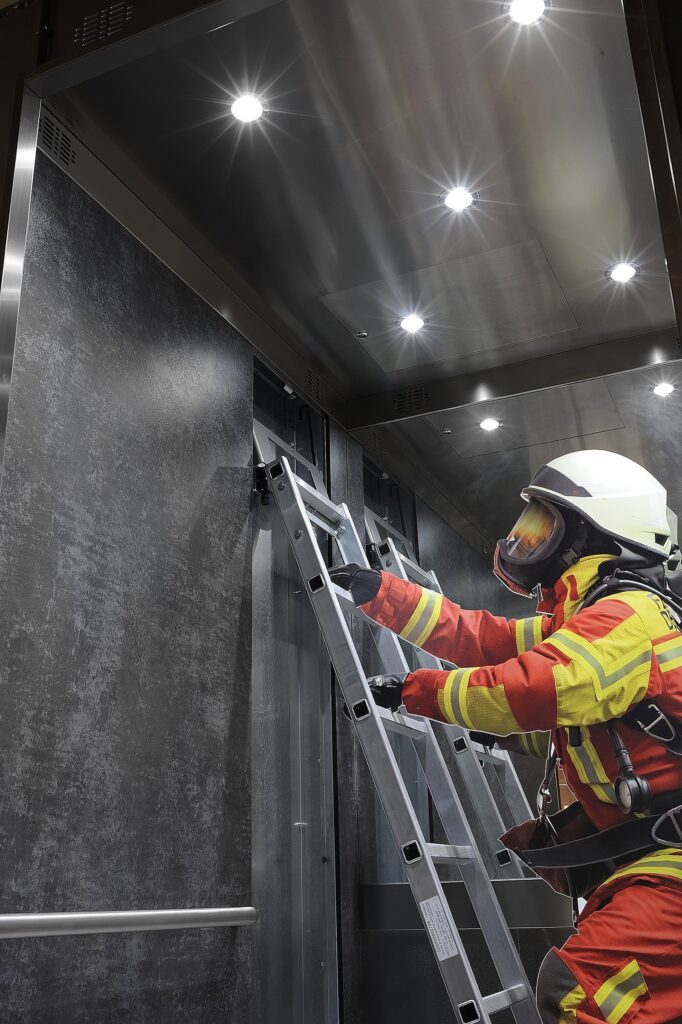
Ladders and trap door for rescue operations
Electrical components in the shaft and on the lift car are protected against water
Emergency intercom system and lift operation
Interface between the lift control, alarm and fire detection systems
Currently, all standard Passenger Lifts must comply with BS EN 81-20. However, Firefighting Lifts must also comply with BS EN 81-72, which covers the safety rules for the construction and installation of firefighters lifts.
Standard lifts are not used in the event of a fire.
Most lifts go to ground level and shut down in the event of an Building Management System (BMS) also referred to as the fire alarm.
However, there are certain types of passenger lifts that can aid the fire and rescue service in accordance with Part 72: Firefighting Lifts.
The difference between a standard Passenger Lift and a Firefighting Lift is vast, but please find below an overview which we hope will help.
A firefighters lift, unlike a normal lift, shall be designed to operate so long as is practicable when there is a fire in parts of the building. Although primarily intended for passenger use, it has additional protection, controls and signals which enable it to be used under the direct control of the fire service.
The grade of material is of a higher specification. This allows for additional protection and weight.
The car and landing controls and associated control system must not register false signals from the effects of heat, smoke or moisture.
A fire evacuation lift requires a specific type of control system, so that it can perform the commands needed when in firefighters mode.
It must reach the furthest floor from the fire service access level within 60 s from after the closing of the lift doors.
Electrical equipment within the fire fighting lift well and on the car, located within 1.0m of any wall containing a landing door, shall be protected from dripping and splashing water or provided with enclosures classified to at least IPX3 according to BS EN 60529.
An emergency trap door shall be provided in the roof of the car.
Any compartment containing the lift machine and its associated equipment shall be provided with at least the same degree of fire protection as is given to the lift well.
Fire lifts must have an intercom system or similar device for interactive two way speech communication.
The London Plan 2021 is the spatial development plan for Greater London over the next 20-25 years. It discusses Emergency Evacuation Procedures, incorporating standards for fire safety of developments and robust strategy for building evacuation.