
Introduction
For many building owners and facilities managers, lift performance is no longer just a maintenance issue, it’s a business-critical priority.
When a lift goes out of service, the impact is immediate. Disruption to tenants, complaints from users, accessibility concerns, and pressure on your team all quickly follow. That’s why more organisations are looking beyond traditional maintenance models and investing in smarter ways to manage their lift systems.
A smart lift system with remote lift monitoring is one of the most effective ways to stay in control.
The Real Cost of Lift Downtime
Lift breakdowns are rarely just a one-off inconvenience. They often lead to:
- Frustrated tenants and visitors
- Increased demand on facilities teams
- Emergency engineer callouts
- Potential compliance and safety risks
In many cases, the biggest issue is not the fault itself, but the time it takes to identify, report, and resolve it.
The longer this process takes, the greater the disruption.
A More Connected Approach to Lift Maintenance
Across the facilities management sector, there is a clear shift towards greater visibility and real-time insight into building systems.
Facilities managers are under increasing pressure to:
- Improve service reliability
- Reduce downtime
- Deliver better value from maintenance contracts
- Provide clear performance data
Remote monitoring supports all these goals by affording instant visibility into what’s happening with your lifts at any given time.
What is Remote Lift Monitoring?
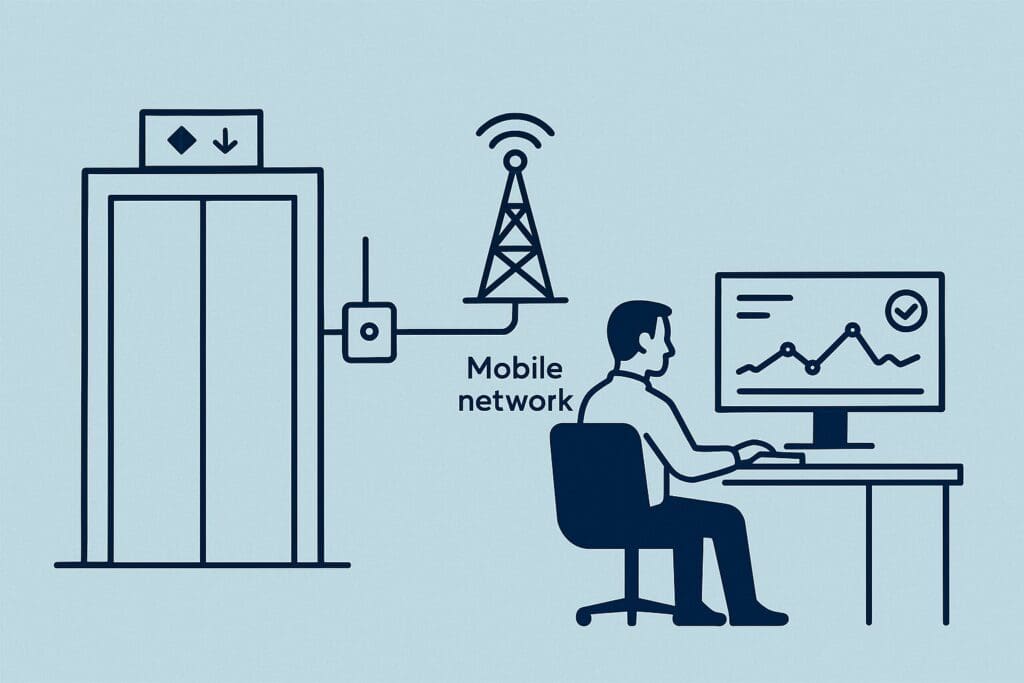
Remote lift monitoring uses connected systems to track lift performance in real time.
When a fault occurs, the system immediately alerts the maintenance provider, allowing action to be taken without delay.
It also enables engineers to:
- Access fault information remotely 24/7
- Understand what’s gone wrong before attending site
- In some cases, resolve issues remotely even without needing to visit
Rather than relying on someone to report a problem, the lift monitoring system reports it for you instantly.
The Key Advantages
1. Immediate Fault Awareness
One of the biggest challenges in lift maintenance is simply knowing there’s a problem.
Remote monitoring eliminates unnecessary delays by:
- Sending instant alerts when faults occur
- Removing reliance on tenants or site staff to report issues
- Providing real-time system visibility
This alone can significantly reduce response times.
2. Faster, More Efficient Callouts
When an engineer attends site with little or no prior information, diagnosis takes time.
Remote monitoring assures:
- Fault data is available in advance
- Engineers arrive better prepared
- The root cause can be identified more quickly
This leads to faster fixes and fewer repeat visits.
3. Remote Diagnosis and Resolution
In some cases, faults don’t require a full site visit.
Remote monitoring enables:
- Real-time system checks
- Remote resets or parameter adjustments
- Immediate intervention for certain fault types
This means some issues can be resolved:
- Faster
- At lower cost
- With minimal disruption
4. Improved Uptime and Reliability
Reliability is a key priority for building owners, often outweighing cost considerations when it comes to lift performance.
By reducing delays in fault reporting and speeding up resolution, remote monitoring helps:
- Keep lifts operational for longer
- Reduce service interruptions
- Improve overall user experience
5. Greater Transparency and Control
Remote monitoring provides clear visibility of: 
- When faults occur
- How quickly they are responded to
- Overall lift performance
This helps facilities managers:
- Track service levels
- Hold suppliers accountable
- Make informed decisions about maintenance strategies
Why Remote Monitoring is Becoming the Standard
The move towards remote monitoring is being driven by several factors:
- Increasing expectations around uptime and service delivery
- More complex lift systems requiring specialist insight
- Pressure on facilities teams to do more with less
- A wider shift towards connected, data-enabled buildings
The technology is now widely available and increasingly adopted as part of modern smart lift management strategies.
Where It Delivers the Most Value
Remote monitoring is particularly beneficial in:
- High-traffic commercial buildings
- Multi-occupancy residential developments
- Public sector environments
- Sites with limited on-site maintenance presence
In these environments, even small response time improvements can make a significant difference.
The Bottom Line
Traditional lift maintenance relies heavily on faults being reported and diagnosed on-site.
Remote monitoring changes this by:
- Identifying issues instantly
- Enabling quicker, more informed responses
- Allowing certain problems to be resolved remotely
The result is simple:
Less downtime, faster fixes, and better overall performance.
How can Ideal Lifts help?
If you’re looking to reduce lift downtime and improve response times across your buildings, remote monitoring is a practical and proven step forward.
To find out how it could work for your lift, speak to our team today.